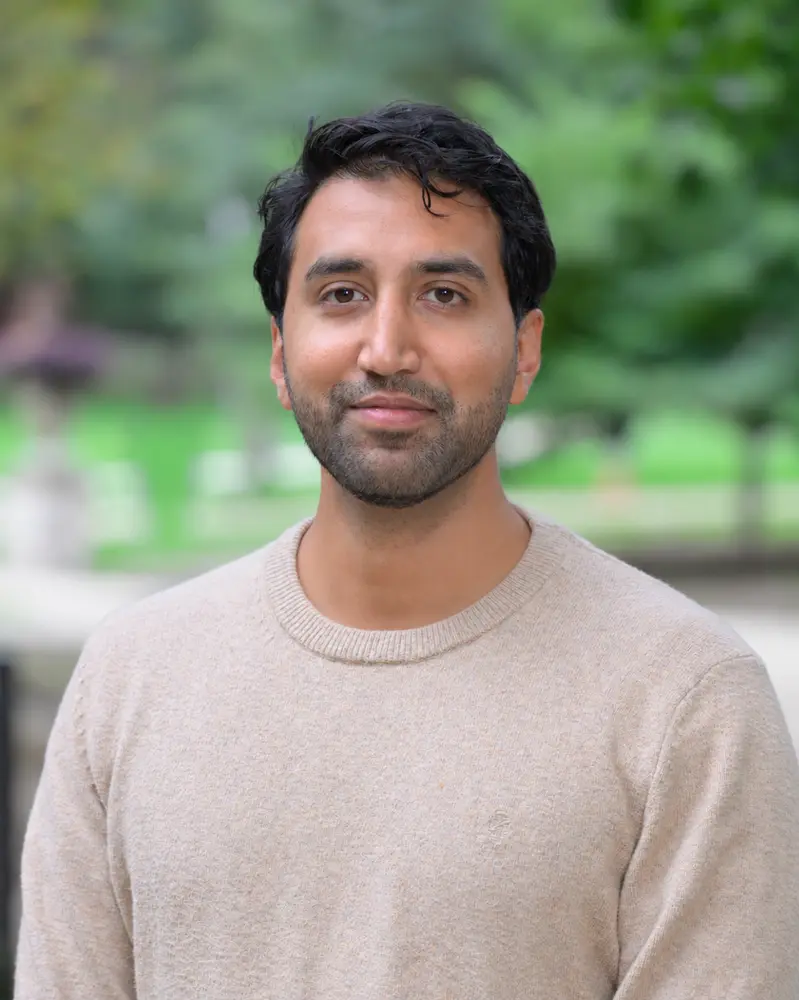
This fall the Department of Philosophy welcomed Firdaus Gupte to our faculty as a lecturer. He finished his PhD at University of Massachusetts Amherst. Gupte's research is focused on the philosophy of science, particularly laws of nature, scientific reasoning, and scientific explanation. Read on for a Q&A to learn more about his research.
What are your research interests and why are you passionate about these areas of study?
My research interests lie in the areas of metaphysics and philosophy of science. In particular, my research concerns the laws of nature. If you open a physics textbook, you will read about all kinds of entities like particles, waves, spacetime, and properties like mass and charge, and physics is able to tell us quite a bit about what these entities are. But you will also read about laws like Newton’s first law of motion or the Einstein Field Equations (the laws of general relativity). Physics doesn’t tell us much about what these entities are, nor is it its job to do so. While the job of physicists is to determine which statements are laws of nature (e.g., are the laws of the actual world the Newtonian laws or the Einstein field equations?) it is not the job of physicists to determine what it is to be a law of nature. That is the job of philosophers.
The question of "what it is" to be a law of nature is interesting in its own right. However, philosophers also think answering this question has important implications for our understanding of the practice of science in general. In particular, the philosophical debate about laws of nature has fascinating connections to our understanding of counterfactuals (statements of the form, "if it were the case that p, it would be the case that q"), causation, and statements about objective chance (statements like “a uranium-232 atom has a .50 chance of decaying in ~68.9 years).
Another important application has to do with the problem of induction, which is what got me interested in philosophy in the first place! When I was a first-year college student, I took Introduction to Philosophy and encountered this problem for the first time. I've been hooked ever since! The world around us is extraordinarily regular. Whenever I drop an apple, it falls. Whenever I eat a piece of bread, it nourishes, not poisons me. Whenever two electrons approach each other, they repel each other. The problem of induction is: why doesn’t the world fall apart? Is there any explanation for this extraordinary regularity we observe? Many philosophers think that understanding what it is to be a law of nature is closely connected to solving the problem of induction.
Why did you decide to join the Department of Philosophy at the University of Illinois?
I decided to join the Department of Philosophy at the University of Illinois because of its growing research strengths in philosophy of science and especially philosophy of physics. A number of faculty work on questions connected to my work, so this department is a great place for someone with my research interests to learn and contribute!
In addition, this department has strong connections to the growing field of the philosophy of AI. I was fortunate to have the opportunity to teach courses in this new and exciting field.
What research projects are you working on right now?
I’m currently working on two research projects. The first project is connected to the laws of nature and the problem of induction. There are two prominent views in the debate about laws of nature, Humeanism and anti-Humeanism. Roughly, Humeanism about laws is the view that the laws are not fundamental, but merely descriptive generalizations about the fundamental facts of the world, whereas anti-Humeanism about laws is the view that laws are fundamental, and govern or guide the facts of the world. Some philosophers claim that anti-Humeanism about laws can help solve the problem of induction. I’m currently working on a project that casts doubt on this claim, arguing that the anti-Humean solution to the problem of induction leads to an infinite regress of explanation.
The second project is more closely connected to metaphysics. In this project, I am extending work on the laws of nature in the philosophy of science to laws of metaphysics. I am developing an account of laws of metaphysics that shares similarities with the popular Humean account of laws of nature. I then apply this account to offer new solutions to a few outstanding problems in metaphysics: the inference problem (how does the law that p guarantee p) and the problem of meta-ground (what explains facts about explanations themselves?).
What classes are you teaching?
I’m currently teaching the Philosophical Foundations of Computer Science, Minds & Machines, and an advanced course on the Ethics of Killing. Next semester, I’m scheduled to teach Intro to Ethics, Minds & Machines, and Philosophy of Mind.
What key ideas or lessons do you hope to impart to your students?
I hope to introduce my students to both the importance and joy of doing philosophy. It’s commonly said that we can’t not do philosophy; we can only do it badly. The idea is that we all have philosophical views, whether or not we recognize them, and confronting these views is inescapable. We can either try to avoid examining our philosophical assumptions, in which case we risk holding poorly developed or inconsistent views, or we can confront them head-on!
Doing philosophy helps us better understand and evaluate our own views about the world. But it also helps us develop a deeper understanding and appreciation of the views of others, including those with whom we disagree. These are skills I hope my students will take with them long after leaving the classroom.