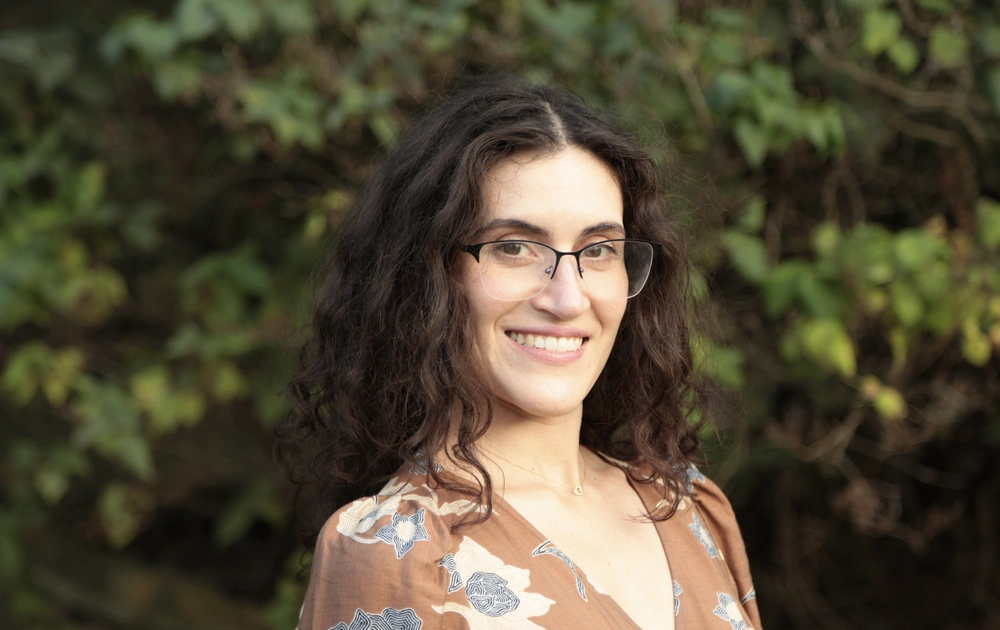
This fall the Department of Philosophy welcomed Areins Pelayo to our faculty as a lecturer. Previously she was a visiting assistant professor at Grand Valley State University. Pelayo's research focuses on early modern philosophy, history and philosophy of science, and Latin American philosophy. Read on for a Q&A to learn more about her research.
What are your research interests and why are you passionate about these areas of study?
My areas of expertise are in early modern philosophy, history and philosophy of science, and Latin American philosophy. My primary projects are driven by questions concerning knowledge. In my early modern work, I investigate what the standards of knowledge are, whether and how these standards fall short of the "ideal" model of knowledge, such as the ancient methods of geometry found in Pappus’s and Euclid’s works. In my Latin American project, I ask a social and political question: who sets the standards for knowledge, who or what determines who is a knower, and whether these authorities should be trusted or resisted.
I find the early modern period fascinating partly because philosophy and science were not yet separated and partly because of a confluence of factors within the period. John Donne’s 1611 "Anatomy of the World" put it precisely when he said that a "new philosophy calls all in doubt": Copernicus’s "De Revolutionibus" (1543) suggested our senses were unreliable; the Reformation suggested that the church and the pope were unreliable sources of divine truth; scholastic syllogistic reasoning and formal causes were criticized for being circular and empty, which undermined the natural philosopher’s traditional education. Amid all the uncertainty, these figures were concerned with reasoning safely, especially about empirical knowledge. My specific research thread is determining the conditions they thought empirical hypotheses needed in order to be justified for safe theorizing, and whether their methods were ultimately successful. The scope spans Descartes to Newton and includes Du Châtelet.
My work in Latin American philosophy is reparative and empowering. Sor Juana Inés de la Cruz and Eugenio María de Hostos were excluded from the philosophical canon, and engaging their works helps correct that injustice. It is my view that it also benefits philosophers and the public epistemically: their arguments facilitate greater understanding of what resistance against theological and colonial power has been, is, and can be. As a Puerto Rican, I find that studying these figures, including how they were excluded and how they theorized about their own struggles with sexism or colonialism helps make sense of my own and (I hope) other marginalized voices’ experiences and challenges as knowers and contributors to knowledge.
My research is historical and relevant: philosophers (e.g., José Medina, Thomas Kuhn) regularly look to the past (and should!) to theorize about today’s issues so that they can consider what has worked, what has not, and what needs to be tried.
Why did you decide to join the Department of Philosophy at the University of Illinois?
What attracted me to Illinois were the department’s strengths in history of philosophy, philosophy of science, and social and political philosophy. It has a thriving intellectual scene with numerous talks and reading groups. I’m currently part of the Logic, Science, and Mathematics Reading Group. The university’s Latin American and Caribbean collection and its Librarian, Professor Antonio Sotomayor, are extraordinary resources for my work on Sor Juana and Hostos. The graduate and undergraduate students are deeply curious and collaborative, and my colleagues are fun interlocutors, stress-testing and improving ideas to see where they could lead. I feel grateful and lucky to be part of this community.
What research projects are you working on right now?
I’ve got a few things underway in both early modern and Latin American philosophy. I recently presented a draft paper, “Truths of Fact and Truths of Reason in Leibniz’s Theory of Hypotheses,” at the Leibniz Society of North America conference, where I received excellent feedback. I will present the paper again at the Eastern APA this January.
Currently, I’m revising a paper on the reception of Descartes’s views on hypotheses. Leibniz, Newton, Locke, and Du Châtelet criticize Descartes’s theory of hypotheses: roughly the view they attribute to him is that hypotheses need not meet any observational conditions to be used in empirical theorizing. I’m investigating why this view came to be attributed to him and what view Descartes actually held.
In Latin American philosophy, my paper “Reason and Resistance in Sor Juana” is forthcoming in Southwestern Philosophy Review, and I’m presenting this work next week in El Paso, Texas. This paper was simultaneously accepted to the Pacific APA conference. However, as I plan to expand some of its themes, I will use the APA conference as an opportunity to present some new ideas that compare Sor Juana with Aquinas.
Lastly, I recently completed a chapter on resistance in Hostos (Forthcoming in The Bloomsbury Handbook of the Americas). I am developing material that did not make into the chapter. Like Kant and Krause, Hostos believed that reason and morality are intimately connected. The new paper is on Hostos’s arguments for the connection between reason and religion and why and how the latter can still be a source of moral authority even though morality ultimately depends on reason.
What classes are you teaching?
I’m currently teaching PHIL 101 Introduction to Philosophy, PHIL 102 Introduction to Logic, and an advanced course on the philosophy of trust (PHIL 380). In the spring, I’m scheduled to teach PHIL 207 Philosophy of Science, PHIL 107 Introduction to Political Philosophy, and PHIL 101 Introduction to Philosophy.
What key ideas or lessons do you hope to impart to your students?
I hope students leave my classes having developed intellectual humility and a habit of kindness and generosity toward their interlocutors. I also intentionally design my classes so that they build autonomy: I want them to form their own beliefs, defend them against objections, and recognize when an objection means that they need to revise their belief(s). Above all, I hope they go on to live more curious and deliberate lives, in their careers, as citizens, and in their relationships with others.