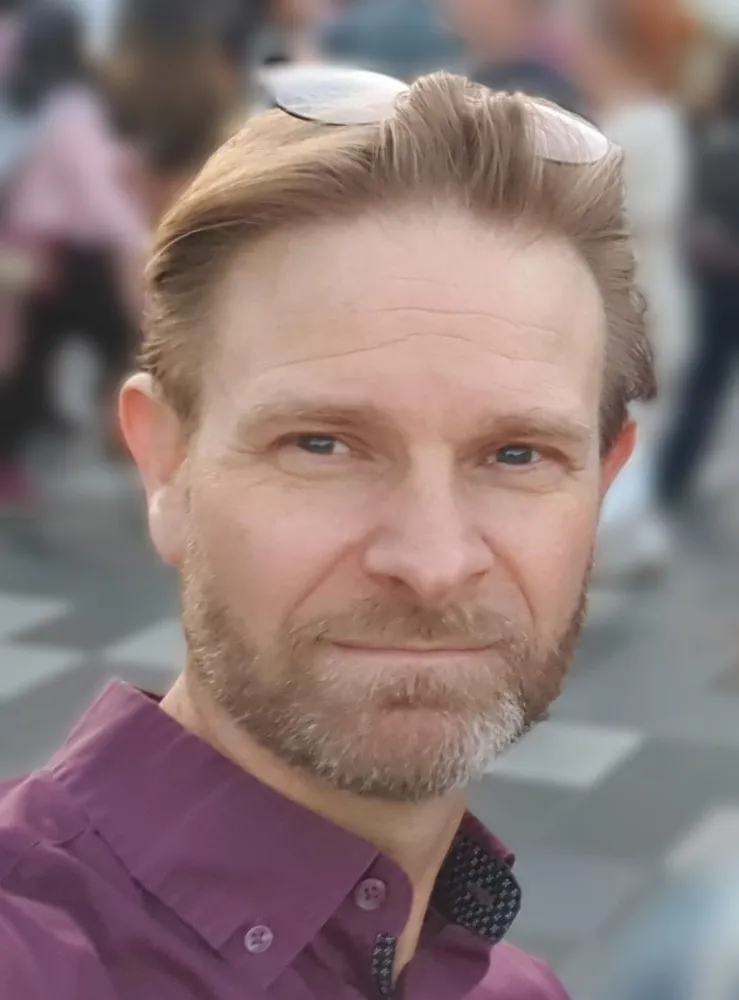
Professor Stephen Finlay will be taking up a 2026-27 Core Fellowship at the Helsinki Collegium for Advanced Study, an interdisciplinary center for humanities and social sciences at the University of Helsinki in Finland. His research project—titled "How Much Objectivity Can We Get?"—will explore a Perspectivist approach to reconciling the tensions between objectivity and subjectivity.
Finlay’s brief description of the project follows: “The idea is helpfully illustrated by the concepts of “left (of)” and “right (of).” If it is asked of two objects, say a Pepsi and a Coke, which of them is on the left, we all quickly recognize that the answer is perspective-dependent in a straightforward way. Supposing the objects are located between you and I, then if the Pepsi is on the left relative to my perspective, it will be on the right relative to your perspective.
“Contrasting with this sensible perspectivist interpretation, there are two absurd alternatives. First, we could be Objectivists about Left and Right: if the Pepsi is on the left (for anyone), then it cannot be on the right (for anyone), and vice versa. Therefore, one of us must be seeing it incorrectly. Second, we could be Subjectivists: there are no facts of the matter, or objective reality, just appearances/ opinions. Clearly we should reject both of these options. There are genuine location facts here, about which someone’s opinions could be true or false. They’re just relational facts: The Pepsi is on the left/right (of the Coke) relative to the position I/you stand in.
“Few people would choose to be Objectivists or Subjectivists about Left/Right. But when it comes to more complex philosophical topics, in which the relativity of the topic is more subtle and latent, the nuanced Perspectivist position is generally overlooked or scorned in favor of endless and futile debates between Objectivism and Subjectivism. The list of these subjects includes: normative and moral theory (what ought we to do?), central issues in epistemology (what ought we to believe?), the interpretation of probability, the nature of modality (necessity and possibility), the nature of consciousness, free will, fundamental ontology (what things are there in the world?).”